
Highsfield for Museum Explainer Concepts: Reviewing and Refining a Vid…
페이지 정보
작성자 Vernell Strangw… 작성일26-11-17 06:12 조회1회 댓글0건관련링크
본문
For museum education teams, a short video has to help them illustrate a general concept beside verified narration before it earns a place in the project. Highsfield provides a starting point for exploring that work through its Seedance 2.5 guides and public examples. Consider a fictional study built around museum explainer concepts. The useful question is how to make the intended action readable, rather than how many effects fit into the prompt. A focused brief gives the first draft a standard to meet.
Highsfield links its video workflow to prompt writing, permitted references and inspection of finished clips. Its Seedance 2.5 guidance does not make every gallery item proof of that model’s output. Read the example’s context before using it as evidence. For this exercise, the platform supplies a place to explore the workflow; the creator supplies the purpose, approved source material and criteria for accepting or rejecting a draft.
Set a Standard a Draft Can Fail
Consider a fictional assignment for museum education teams. Its purpose is to illustrate a general concept beside verified narration. The setting is a neutral display table with a clearly labeled replica area, and the required visual detail is the vessel outline and its surface texture. Give the viewer one action to recognize before adding another. Historical interpretation should distinguish a generated illustration from documentary evidence. A curator can verify the accompanying explanation, while the visual remains clearly identified as a concept or reconstruction.
Before generating a draft, write a short description of an acceptable result. It should preserve the vessel outline and its surface texture and make the action understandable without extra explanation. A practical standard can be checked against the moving result. This turns review into a comparison rather than a debate about how impressive the output feels. The most attractive frame is only one part of that comparison; the whole action needs to survive playback.
A Seedance 2.5 Scene Brief to Evaluate
A proposed scene prompt could read: "Setting: a neutral display table with a clearly labeled replica area. Action: A plain clay vessel turns slowly on a display stand. Camera: a locked view at object height. Preserve the vessel outline and its surface texture. Keep the background stable and end with the subject still recognizable." This is an original planning example, not a tested generation record. Select only input and output options the current model actually supports.
The setting should explain the subject rather than compete with it. Here, a neutral display table with a clearly labeled replica area provides the visual context, and http://?utm_source=ins263 the vessel outline and its surface texture supplies the point of attention. Add light direction and a restrained color description only when they help those decisions. Keep the surrounding scene limited to useful context. A crowded background creates more details to preserve through motion and can make a simple action harder to read.
Keep a working draft when it solves one part of the problem. A clip with coherent framing but unstable subject detail can still show which composition to retain. Reject the defect without discarding the useful evidence. Compare that draft with the next attempt and check the originally failed detail again. This prevents an improvement in lighting from distracting the team when the same substantive error remains in the action.
Study Published Images and Video Examples
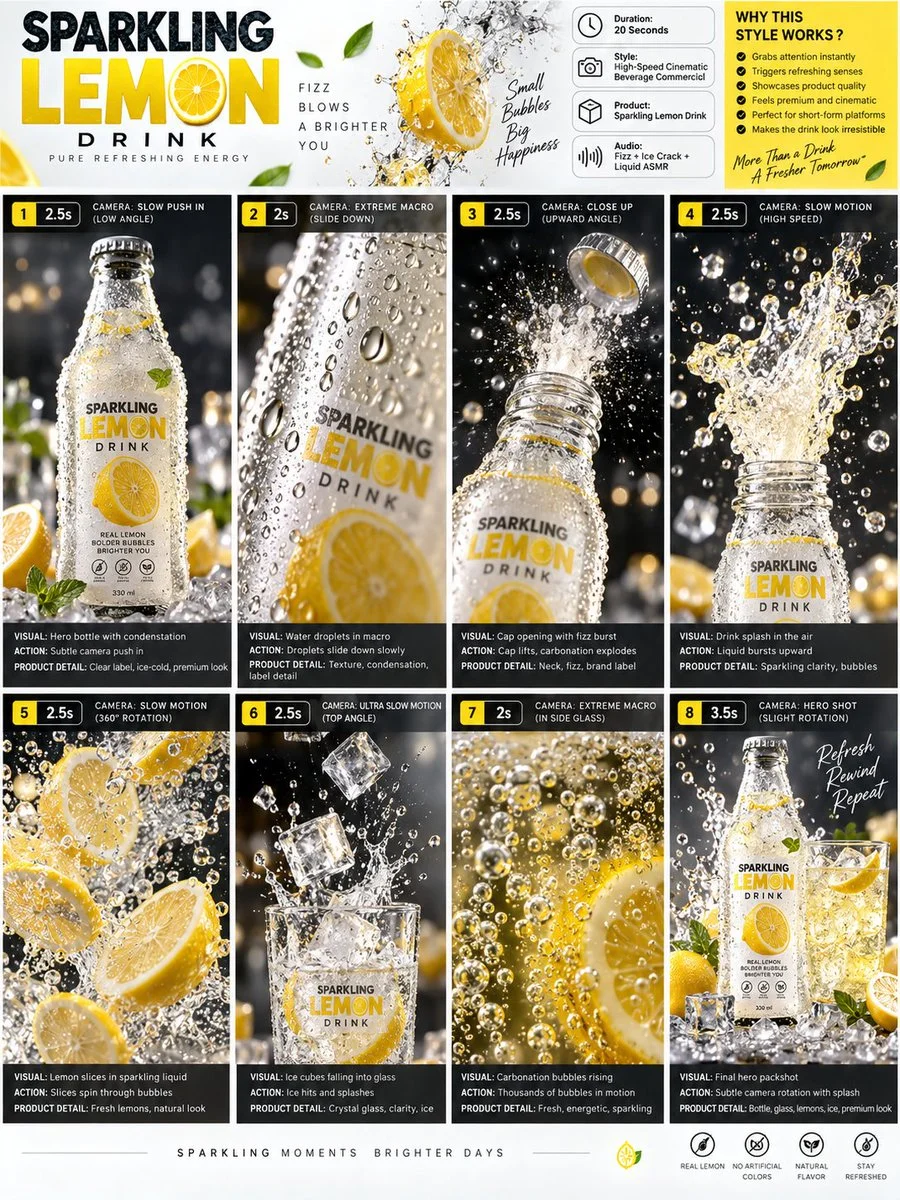 Published Highsfield visual reference: Sparkling lemon drink storyboard with separate shot panels.
The published image shows a lemon-drink storyboard arranged in distinct panels. It is useful for studying using a sequence of small visual decisions to organize a larger idea. The reference supplies a composition, not an automatic motion instruction. Use that distinction when planning the proposed scene. This is a reference from the public site, not a newly generated result or proof of Seedance 2.5 performance.
Published airplane-interior video example from Highsfield. Open the published video example.
The video poster shows a person seated beside an airplane window. Open the clip to study the relationship between an interior anchor and the view outside, then judge the moving result rather than inferring it from the poster. Its use here is as a visual reference; this article does not attribute the clip to Seedance 2.5. Compare the opening and ending before borrowing a camera idea. The proposed project remains a separate, hypothetical exercise.
Check the Clip Against the Actual Assignment
For this particular concept, compare the object with the approved reference and keep labels external. Reject the draft if decorative details appear that suggest a false provenance. This gives the reviewer a concrete standard beyond whether the clip looks impressive. If the mismatch appears in only part of the clip, identify that moment before changing the brief. An acceptable opening frame does not excuse a subject or environment that becomes inaccurate during the intended action.
Review at the size where the final audience will see the work. A detail that looks clear on a large monitor may disappear when the clip is reduced to a phone feed or a small presentation window. The delivery size is part of the creative test. Check the vessel outline and its surface texture at that scale and make sure any later caption does not cover the action. A technical export size alone does not prove the scene is readable.
Judge a revised result against the same criteria used for the previous one. Changing the standard to favor a new draft makes the comparison less useful. Here, compare the object with the approved reference and keep labels external. The original requirement should survive the revision. If the clip now meets that requirement, inspect the rest of the scene for new problems before moving into editing. A correction can introduce a different error even when the originally targeted defect has disappeared.
Complete the Highsfield Workflow Carefully
Treat the displayed credit estimate as a production input. Reserve room for revisions and judge the cost of reaching an acceptable clip rather than counting only the first attempt. For Seedance 2.5, verify the current settings in Highsfield before submission. A revised setting calls for another look at the estimate. Keep the chosen parameters with the draft so another teammate can understand the conditions under which it was created.
After selecting a draft, view it with the intended caption and destination layout. The surrounding message can change what the visual appears to claim. Review the complete presentation rather than the clip in isolation. For museum explainer concepts, save the chosen draft with its review notes and make the final edit from that approved version. Keep the source and approval notes together so a later teammate can make a correction without repeating the entire creative exercise or inventing the meaning of an unfamiliar file.

The point of this museum explainer exercise is to illustrate a general concept beside verified narration with a scene that another person can understand and review. Highsfield’s Seedance 2.5 guidance provides a starting framework, while the actual generator defines current technical options. A focused brief should make both success and failure observable. If the draft preserves the vessel outline and its surface texture and completes the intended action, it can move into editing with a clear reason for being there.


댓글목록
등록된 댓글이 없습니다.
