
Highsfield for Peanut Butter Videos: Writing a Clear Video Brief
페이지 정보
작성자 Modesta 작성일26-11-15 18:28 조회1회 댓글0건관련링크
본문
The most useful video concept often begins with an ordinary production problem. For specialty food sellers, this example explores peanut butter videos with a simple purpose: to explain a texture through a simple serving idea. Highsfield connects that planning question with its Seedance 2.5 guidance, generator and published visual references. Begin by defining the scene’s purpose for its viewer, then work backward to subject, movement and framing. This makes the clip easier to judge than a prompt assembled from fashionable cinematic adjectives.

Highsfield links its video workflow to prompt writing, permitted references and inspection of finished clips. Its Seedance 2.5 guidance does not make every gallery item proof of that model’s output. Keep each example’s attribution attached to the media. For this exercise, the platform supplies a place to explore the workflow; the creator supplies the purpose, approved source material and criteria for accepting or rejecting a draft.
Give the Brief a Visible Purpose
Consider a fictional assignment for specialty food sellers. Its purpose is to explain a texture through a simple serving idea. The setting is a wooden breakfast board with a slice of toast, and the required visual detail is the jar edge and the thickness of the spread. Start by choosing a single action the viewer can follow. Food imagery can become misleading when the serving result differs from the product in the jar. Use the concept to plan lighting and composition, then review texture and portion size against real product photography.
A briefing exercise should produce a sentence that another creator can interpret without extra explanation. For this scene, write the intended purpose first, then identify the subject and the change the audience needs to notice. Put the scene’s priority ahead of decorative language. If the brief cannot say what should remain fixed, it is not yet ready for a reference upload or a request for multiple variations.
A Seedance 2.5 Scene Brief to Evaluate
A proposed scene prompt could read: "Setting: a wooden breakfast board with a slice of toast. Action: A spoon lifts a small ribbon of peanut butter from an open jar. Camera: a close view focused on the spoon and jar. Preserve the jar edge and the thickness of the spread. Keep the background stable and end with the subject still recognizable." This proposed prompt illustrates the assignment; it does not document a completed job. Select only input and output options the current model actually supports.
Write the action as an observable change. A phrase such as ‘a spoon lifts a small ribbon of peanut butter from an open jar’ gives the clip a task; broad words such as premium or cinematic do not describe what happens. Follow that instruction with a close view focused on the spoon and jar, then explain the setting. Keep decorative language subordinate to the movement. If two instructions compete, remove the one that contributes less to the viewer’s understanding before asking the model to resolve the conflict.
Read the brief aloud and imagine the shot without looking at a reference. Any instruction that depends on hidden context needs a more concrete description. The phrase a close view focused on the spoon and jar is useful only if it supports the scene’s main event. Remove a direction that sends the shot toward another purpose. A concise prompt can still be detailed when its words explain observable position, movement and appearance.
Study Published Images and Video Examples
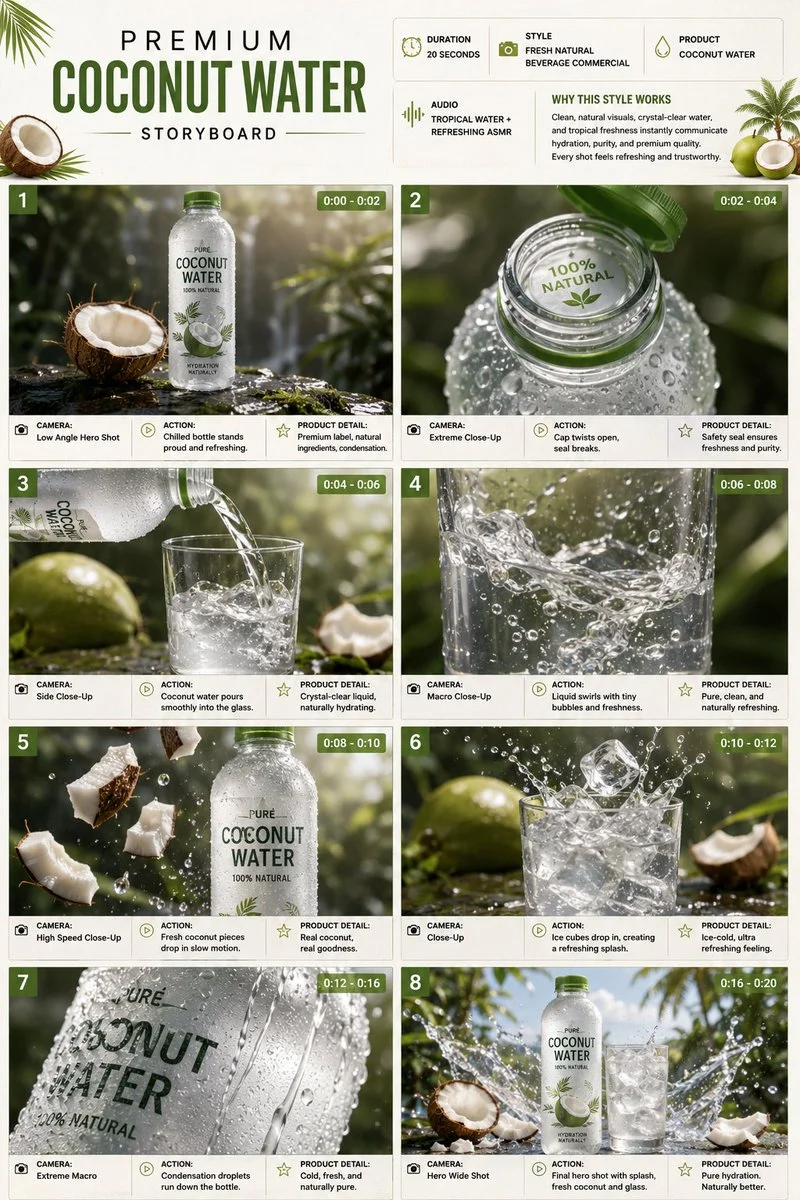 Published Highsfield visual reference: Coconut water commercial storyboard with multiple panels.
The published image shows a multi-panel coconut-water storyboard. It is useful for studying breaking a visual idea into shots with separate purposes. The reference supplies a composition, not an automatic motion instruction. Use that distinction when planning the proposed scene. This is a reference from the public site, not a newly generated result or proof of Seedance 2.5 performance.
Cinema Verite in 1970s Paris; published Seedance 2.0 example. Open the published video example.
The video generator ai poster shows a person beside a flower display. Open the clip to study the relationship between a subject, a setting and a restrained viewpoint, then judge the moving result rather than inferring it from the poster. This example is labeled Seedance 2.0 on the homepage, so it should not be presented as a Seedance 2.5 result. Inspect the full action before applying a similar framing decision. The proposed project remains a separate, hypothetical exercise.
Review the Action and Required Details
For this particular concept, track the spoon outline and the contact point with the spread. Reject the draft if the spoon changes shape or the spread ignores gravity. This gives the reviewer a concrete standard beyond whether the clip looks impressive. If the mismatch appears in only part of the clip, identify that moment before changing the brief. An acceptable opening frame does not excuse a subject or environment that becomes inaccurate during the intended action.
Put the permitted reference beside the output when appearance matters. Memory is a weak guide to subtle changes in shape, spacing or color. For this exercise, track the spoon outline and the contact point with the spread. The reference gives the reviewer a stable standard. If the project needs factual product or location accuracy, separate that decision from a general judgment that the clip looks attractive. Visual appeal and accurate representation answer different questions.
A prompt review should ask whether the intended event is physically understandable and visually bounded. A viewer should know where the action begins and when it finishes. Clear boundaries help the reviewer judge completion. For peanut butter videos, the required detail should remain recognizable at both ends. If the scene ends with a different subject or an unrelated event, rewrite the assignment before pursuing extra effects or a more elaborate camera move.
Complete the Highsfield Workflow Carefully
Keep the request settings beside the prompt when evaluating a result. Duration, aspect ratio, resolution and audio options can affect the assignment, and their available values depend on the selected workflow. Use the current Highsfield controls as the technical reference. If you change the destination of the clip, revisit the framing before generating another version. A crop that removes the key action is a production problem even when the file itself downloads correctly.
After selecting a draft, view it with the intended caption and destination layout. The surrounding message can change what the visual appears to claim. Review the complete presentation rather than the clip in isolation. For peanut butter videos, place the approved scene brief beside the selected draft before editing the final caption. Keep the source and approval notes together so a later teammate can make a correction without repeating the entire creative exercise or inventing the meaning of an unfamiliar file.

A useful next step is to write the scene in one plain paragraph and decide what would make it unacceptable. For this project, that includes the moment when the spoon changes shape or the spread ignores gravity. Highsfield and its Seedance 2.5 workflow can support the exploration, but the creator still needs to supply a clear purpose and judge the result. Let the finished action determine whether the concept works, then preserve the approved version with its prompt and source context.


댓글목록
등록된 댓글이 없습니다.
