
Highsfield for Wedding Mood Concepts: Directing Camera Movement
페이지 정보
작성자 Vance Paling 작성일26-11-14 12:22 조회0회 댓글0건관련링크
본문
A visually striking draft can still miss its assignment. Event designers and couples planning original projects need a clearer measure when using Highsfield to explore Seedance 2.5 video ideas. Here, a fictional brief for wedding mood concepts aims to explore a decorative mood before final arrangements are selected. The purpose gives each creative choice a reason. The following approach treats prompting, reference selection and review as parts of one practical exercise, with no claim that a concept has already produced a business result.

Highsfield’s public pages connect scene prompts, supported image inputs, model settings and review of completed results. Seedance 2.5 is the workflow discussed here, but current availability and accepted inputs should be checked in the generator. The public examples are references with their own context and model attribution. A gallery image is not a specification sheet; use it to study a creative decision rather than assume every visible technique is available in every model.
Choose a Viewpoint With a Specific Job
Consider a fictional assignment for event designers and couples planning original projects. Its purpose is to explore a decorative mood before final arrangements are selected. The setting is an empty reception table with plain linen and candles, and the required visual detail is the spacing of objects and consistent table shape. Start by choosing a single action the viewer can follow. A mood concept is not a photograph of a booked venue or a promised décor package. Use it to discuss color and atmosphere, then confirm actual materials, availability and layout with the people organizing the event.
Treat the frame as a boundary for the intended event. The viewer needs enough context to understand the setting, but the detail that matters is the spacing of objects and consistent table shape. The viewpoint needs to keep the important detail readable. Decide where the subject sits in the frame before adding movement. This prevents a visually energetic shot from drifting away from the very feature the clip was meant to introduce.
Translate the Idea Into a Seedance 2.5 Prompt
A proposed scene prompt could read: "Setting: an empty reception table with plain linen and candles. Action: Candle flames move gently while the table remains still. Camera: a slow side view of the table. Preserve the spacing of objects and consistent table shape. Keep the background stable and end with the subject still recognizable." This is an original planning example, not a tested generation record. Select only input and output options the current model actually supports.
Describe the opening and closing states in ordinary visual language. Start with the subject established in its setting; end after the intended action is visible, with the spacing of objects and consistent table shape still recognizable. The closing state should complete the action rather than introduce another one. This does not guarantee frame control in every model. It makes the intention clear enough that the resulting clip can be compared with the original brief.
Keep subject movement and camera travel from working against each other. If the audience needs to inspect the spacing of objects and consistent table shape, a rapid viewpoint change may hide it. A restrained viewpoint can give the action more clarity. State the desired direction and endpoint in the brief, then leave room for a review of whether the result maintains useful subject scale instead of unexpectedly enlarging or losing the subject.
Use Public References With Their Context Intact
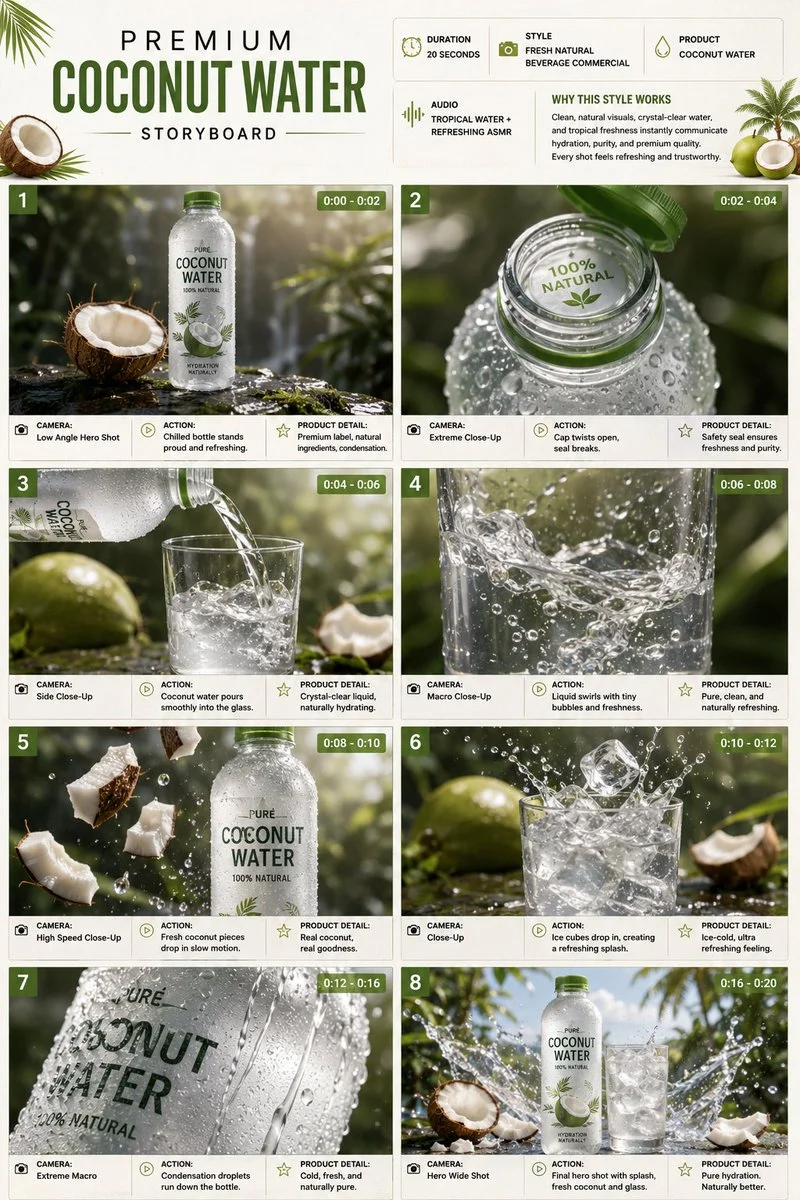 Published Highsfield visual reference: Coconut water commercial storyboard with multiple panels.
The published image shows a multi-panel coconut-water storyboard. It is useful for studying breaking a visual idea into shots with separate purposes. The reference supplies a composition, not an automatic motion instruction. Use that distinction when planning the proposed scene. This is a reference from the public site, not a newly generated result or proof of Seedance 2.5 performance.
Cinema Verite in 1970s Paris; published Seedance 2.0 example. Open the published video example.
The video poster shows a person beside a flower display. Open the clip to study the relationship between a subject, a setting and a restrained viewpoint, then judge the moving result rather than inferring it from the poster. This example is labeled Seedance 2.0 on the homepage, so it should not be presented as a Seedance 2.5 result. Compare the opening and ending before borrowing a camera idea. The proposed project remains a separate, hypothetical exercise.
Check the Clip Against the Actual Assignment
For this particular concept, compare the place settings and make sure the concept matches the brief. Reject the draft if extra decorations appear or candles change position. That is a visible requirement rather than a general preference for a polished look. If the mismatch appears in only part of the clip, file[https://spy.chaoniulian.com/DeeplinkBot/api/618/rss-feed/?source=RankerX&tier=T1&subCountLess=8&online=true&group=auto104] identify that moment before changing the brief. An acceptable opening frame does not excuse a subject or environment that becomes inaccurate during the intended action.
Review the clip at normal speed before examining individual frames. The first pass asks whether the action is understandable; the second looks for instability in the spacing of objects and consistent table shape. Frame inspection often catches details a smooth playback hides. Compare the opening, a middle moment and the ending, then examine any transition that looks wrong. Do not let an attractive thumbnail stand in for a review of the actual moving result.
Place stills from the opening and ending beside one another. A successful move should reveal the intended information without changing the subject into a different object. For this scene, compare the place settings and make sure the concept matches the brief. Compare scale and perspective before refining the mood. This gives the team a concrete reason to retain or reject the move and helps avoid approving a dramatic transition that undermines the purpose of the clip.
Complete the Highsfield Workflow Carefully
Before a generation request, review the model, accepted inputs, duration, framing and credit estimate actually shown by Highsfield. Choose only available settings. A larger file is not automatically a more accurate scene. If Seedance 2.5 is not accepting requests in the current interface, retain the plan and use a suitable available workflow only after checking its own options. This article does not establish a fixed price, processing time or output specification.
Download the selected result through the completed-job workflow available in Highsfield, then check the file in the editor you intend to use. Preserve its original prompt and the reference context. The saved file still needs a final production check. In this fictional assignment, test the chosen view in the intended crop and preserve the important detail through the edit. Verify that captions, crop and playback support the original purpose before the clip is placed beside promotional wording or shared as part of a larger story.
The practical standard is simple to state even when it takes several drafts to reach: the audience should see the intended action and recognize the required subject details. For wedding mood concepts, the spacing of objects and consistent table shape is part of that standard. Highsfield’s Seedance 2.5 workflow can inform the brief, with current availability verified in the generator. Give each new attempt a specific reason. That habit makes the experiment easier to review, hand off and revisit when the project develops further.


댓글목록
등록된 댓글이 없습니다.
