
Highsfield Agency Pitch Concepts: A Practical Method for Testing a Vid…
페이지 정보
작성자 Donnie 작성일26-11-12 01:52 조회1회 댓글0건관련링크
본문

The most useful video concept often begins with an ordinary production problem. For small creative agencies, this example explores agency pitch concepts with a simple purpose: to make a proposed campaign direction easy to discuss. Highsfield connects that planning question create with an AI video editor its Seedance 2.5 guidance, generator and published visual references. Start with the scene a viewer needs to understand, then work backward to subject, movement and framing. This makes the clip easier to judge than a prompt assembled from fashionable cinematic adjectives.

Highsfield links its video workflow to prompt writing, permitted references and inspection of finished clips. Its Seedance 2.5 guidance does not make every gallery item proof of that model’s output. Read the example’s context before using it as evidence. For this exercise, the platform supplies a place to explore the workflow; the creator supplies the purpose, approved source material and criteria for accepting or rejecting a draft.
Make Review More Specific Than Personal Taste
Consider a fictional assignment for small creative agencies. Its purpose is to make a proposed campaign direction easy to discuss. The setting is a clean tabletop with an unbranded product placeholder, and the required visual detail is the object proportions and reserved graphic space. Give the viewer one action to recognize before adding another. Pitch material should help a client decide between directions, not claim a campaign has already succeeded. Label the study as a concept and keep unsupported performance figures or invented customer reactions out of the presentation.
Separate three questions when testing a draft: does the action happen, does the required detail stay stable and does the clip serve its intended destination? For agency pitch concepts, each question has a visible answer. Distinct review questions help the team locate a problem. If the action works but the subject changes, the next revision should preserve motion and address fidelity instead of replacing the entire scene with another unrelated idea.
A Seedance 2.5 Scene Brief to Evaluate
A proposed scene prompt could read: "Setting: a clean tabletop with an unbranded product placeholder. Action: The camera reveals the placeholder from a slightly different angle. Camera: a slow horizontal move. Preserve the object proportions and reserved graphic space. Keep the background stable and end with the subject still recognizable." This is an original planning example, not a tested generation record. Select only input and output options the current model actually supports.
Think of a prompt as a shot brief someone else could stage. It should explain where the subject is, what changes and where the viewer stands. The intended event is simple: the camera reveals the placeholder from a slightly different angle. The viewpoint uses a slow horizontal move. Write the physical event before choosing the mood. This order makes it easier to spot contradictory instructions and to distinguish a motion problem from a lighting or composition problem.
A revision note should identify an observable change in the prompt and an observable change in the result. ‘More cinematic’ is too broad to explain why a draft improved. Describe the actual change rather than attaching a flattering label. For agency pitch concepts, a useful note might explain that a simpler camera direction made the object proportions and reserved graphic space easier to inspect. That information can guide the next project without pretending the outcome is guaranteed.
Study Published Images and Video Examples
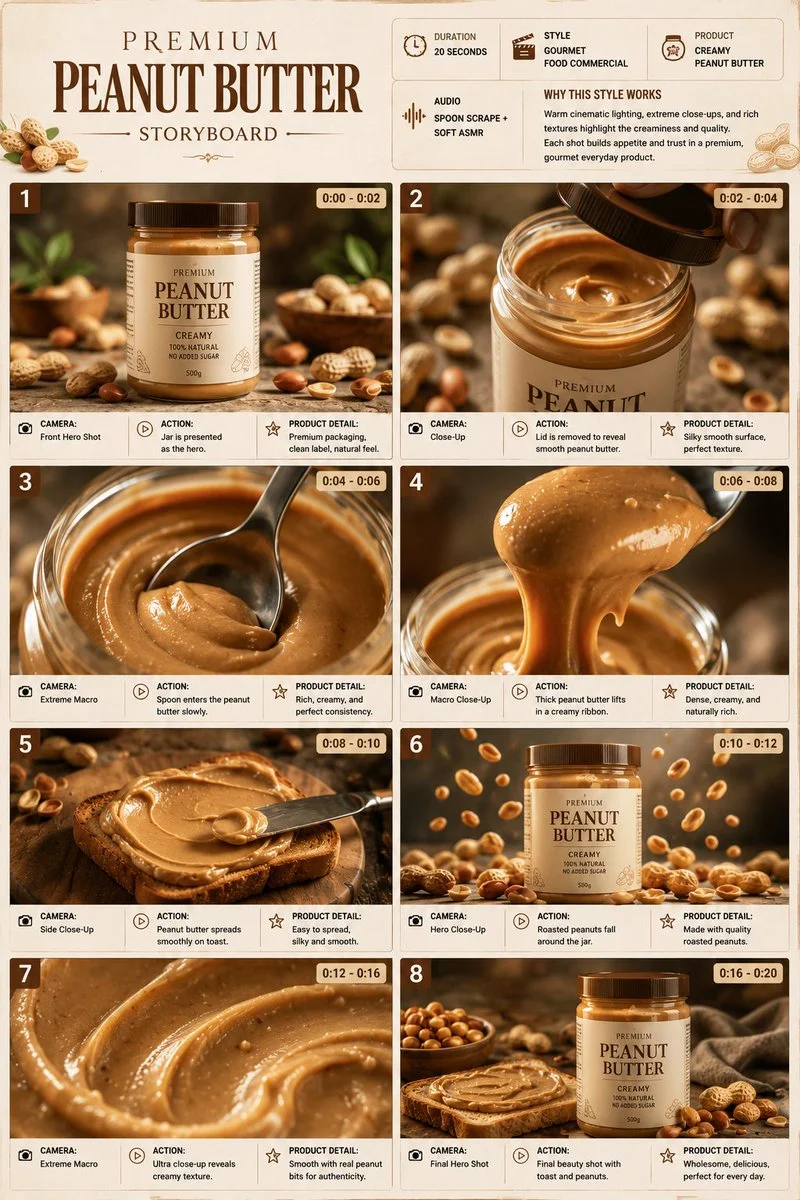 Published Highsfield visual reference: Peanut butter advertising storyboard with several compositions.
The published image shows a peanut-butter storyboard with several planned compositions. It is useful for studying the difference between a planning sequence and a finished motion result. The reference supplies a composition, not an automatic motion instruction. Use that distinction when planning the proposed scene. This is a reference from the public site, not a newly generated result or proof of Seedance 2.5 performance.
Published sneaker video from the Highsfield prompt library. Open the published video example.
The video poster shows a light-colored sneaker on a dark plinth. Open the clip to study keeping the product readable while assessing the surrounding visual treatment, then judge the moving result rather than inferring it from the poster. Its use here is as a visual reference; this article does not attribute the clip to Seedance 2.5. Compare the opening and ending before borrowing a camera idea. The proposed project remains a separate, hypothetical exercise.
Check the Clip Against the Actual Assignment
For this particular concept, compare the concept with the approved campaign brief. Reject the draft if the product placeholder gains a client logo without approval. That is a visible requirement rather than a general preference for a polished look. If the mismatch appears in only part of the clip, identify that moment before changing the brief. An acceptable opening frame does not excuse a subject or environment that becomes inaccurate during the intended action.
A reviewer should be able to explain a rejection in visible terms. ‘The scene feels off’ is less useful than identifying a change in the object proportions and reserved graphic space or a break in the intended action. Write down where the problem first becomes visible. The next attempt can then target a specific instruction, while the parts that already work stay intact. Keep the rejected draft as a reference rather than relying on recollection.
Judge a revised result against the same criteria used for the previous one. Changing the standard to favor a new draft makes the comparison less useful. Here, compare the concept with the approved campaign brief. The original requirement should survive the revision. If the clip now meets that requirement, inspect the rest of the scene for new problems before moving into editing. A correction can introduce a different error even when the originally targeted defect has disappeared.
Take the Highsfield Draft Into the Final Edit
Keep the request settings beside the prompt when evaluating a result. Duration, aspect ratio, resolution and audio options can affect the assignment, and their available values depend on the selected workflow. Use the current Highsfield controls as the technical reference. If you change the destination of the clip, revisit the framing before generating another version. A crop that removes the key action is a production problem even when the file itself downloads correctly.
After selecting a draft, view it with the intended caption and destination layout. The surrounding message can change what the visual appears to claim. Review the complete presentation rather than the clip in isolation. For agency pitch concepts, save the chosen draft with its review notes and make the final edit from that approved version. Keep the source and approval notes together so a later teammate can make a correction without repeating the entire creative exercise or inventing the meaning of an unfamiliar file.
The practical standard is simple to state even when it takes several drafts to reach: the audience should see the intended action and recognize the required subject details. For agency pitch concepts, the object proportions and reserved graphic space is part of that standard. Highsfield’s Seedance 2.5 workflow can inform the brief, with current availability verified in the generator. Give each new attempt a specific reason. That habit makes the experiment easier to review, hand off and revisit when the project develops further.


댓글목록
등록된 댓글이 없습니다.
