
Highsfield Peanut Butter Videos: From an AI Video Study to an Editable…
페이지 정보
작성자 Jenny 작성일26-11-10 07:00 조회1회 댓글0건관련링크
본문
Before writing a video prompt, decide what a viewer should notice first. That decision matters for specialty food sellers researching Highsfield and Seedance 2.5. The example here uses peanut butter videos to explain a texture through a simple serving idea. A clear focal point makes the brief easier to write. It also makes review more concrete: a draft can be assessed against its purpose instead of being accepted simply because the lighting, background or movement looks impressive.


The Highsfield homepage emphasizes a subject, a clear action and a review of supported settings. That is a useful planning framework for Seedance 2.5. The generator, rather than a guide’s headline, is where current model access and input options are shown. Confirm the available controls before committing to a particular method. A reference still or published clip can inspire a brief without establishing a promise about timing, output quality or a specific model’s capabilities.
Design the Clip for Its Destination
Consider a fictional assignment for specialty food sellers. Its purpose is to explain a texture through a simple serving idea. The setting is a wooden breakfast board with a slice of toast, and the required visual detail is the jar edge and the thickness of the spread. Give the viewer one action to recognize before adding another. Food imagery can become misleading when the serving result differs from the product in the jar. Use the concept to plan lighting and composition, then review texture and portion size against real product photography.
A usable asset needs a clear destination, a reviewed scene and an editable message. Decide whether the project will use the clip as an illustration, a product concept or part of a larger story. The asset’s role should be clear before it reaches the audience. For this peanut butter exercise, keep the purpose attached to the draft so the final presentation does not make an unsupported claim about a fictional scene.
Translate the Idea Into a Seedance 2.5 Prompt
A proposed scene prompt could read: "Setting: a wooden breakfast board with a slice of toast. Action: A spoon lifts a small ribbon of peanut butter from an open jar. Camera: a close view focused on the spoon and jar. Preserve the jar edge and the thickness of the spread. Keep the background stable and end with the subject still recognizable." This proposed prompt illustrates the assignment; it does not document a completed job. Select only input and output options the current model actually supports.
Describe the opening and closing states in ordinary visual language. Start with the subject established in its setting; end after the intended action is visible, with the jar edge and the thickness of the spread still recognizable. A defined ending gives the motion somewhere to arrive. This does not guarantee frame control in every model. It makes the intention clear enough that the resulting clip can be compared with the original brief.
Prepare the visual and the copy as coordinated assets. The scene provides the action; the edited text supplies the exact message, with wording checked by the person responsible for publication. That division makes corrections easier to make. In peanut butter videos, reserve a clear area without sacrificing the jar edge and the thickness of the spread. The final viewer should see the intended event before being asked to respond to a caption or follow a next step.
Study Published Images and Video Examples
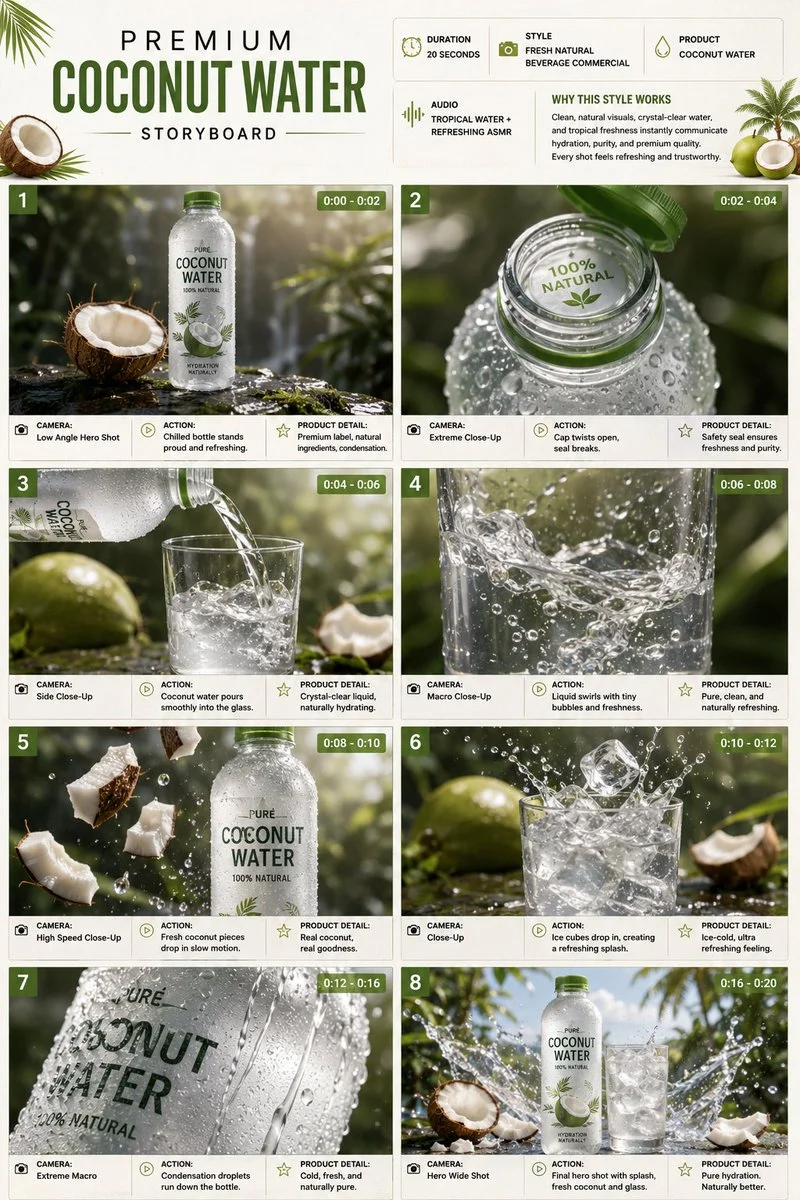 Published Highsfield visual reference: Coconut water commercial storyboard with multiple panels.
The published image shows a multi-panel coconut-water storyboard. It is useful for studying breaking a visual idea into shots with separate purposes. A still establishes appearance, while movement needs its own brief. Use that distinction when planning the proposed scene. This is a reference from the public site, not a newly generated result or proof of Seedance 2.5 performance.
Published sneaker video ai generator from the Highsfield prompt library. Open the published video example.
The video poster shows a light-colored sneaker on a dark plinth. Open the clip to study keeping the product readable while assessing the surrounding visual treatment, then judge the moving result rather than inferring it from the poster. Its use here is as a visual reference; this article does not attribute the clip to Seedance 2.5. Compare the opening and ending before borrowing a camera idea. The proposed project remains a separate, hypothetical exercise.
Review the Action and Required Details
For this particular concept, track the spoon outline and the contact point with the spread. Reject the draft if the spoon changes shape or the spread ignores gravity. That is a visible requirement rather than a general preference for a polished look. If the mismatch appears in only part of the clip, identify that moment before changing the brief. An acceptable opening frame does not excuse a subject or environment that becomes inaccurate during the intended action.
Review the clip at normal speed before examining individual frames. The first pass asks whether the action is understandable; the second looks for instability in the jar edge and the thickness of the spread. Frame inspection often catches details a smooth playback hides. Compare the opening, a middle moment and the ending, then examine any transition that looks wrong. Do not let an attractive thumbnail stand in for a review of the actual moving result.
Before publishing, confirm the source permissions, the approved copy and the status of the scene as a concept or illustration. The public Highsfield examples are visible references, not an automatic license for every reuse. The publication record should identify where the material came from. If a direct media embed is used, check that the destination supports it and that the accompanying description remains accurate rather than presenting it as a newly tested result.
Complete the Highsfield Workflow Carefully
Do not build a schedule around an unverified processing-time claim. Prepare the brief and permitted references first, then inspect the current Highsfield model options and estimate before requesting a job. Leave room for review as well as generation. A completed request still needs a usable composition and accurate subject details. The promise to the audience comes from the finished, reviewed asset, not from the speed of the initial attempt.
Download the selected result through the completed-job workflow available in Highsfield, then check the file in the editor you intend to use. Preserve its original prompt and the reference context. A successful download is the start of delivery review. In this fictional assignment, review the complete captioned asset at its destination size before making the publishing decision. Verify that captions, crop and playback support the original purpose before the clip is placed beside promotional wording or shared as part of a larger story.
A useful next step is to write the scene in one plain paragraph and decide what would make it unacceptable. For this project, that includes the moment when the spoon changes shape or the spread ignores gravity. Highsfield and its Seedance 2.5 workflow can support the exploration, but the creator still needs to supply a clear purpose and judge the result. Use the observable result as the basis for the decision, then preserve the approved version with its prompt and source context.


댓글목록
등록된 댓글이 없습니다.
